
Beyond These Stars crafting recipes turn a handful of raw materials on Kewa's back into the food, clothing, and advanced goods that keep a late settlement alive. The game launched on October 16, 2026, so the only authoritative source right now is Balancing Monkey Games on YouTube and the developer's own articles hub, and neither one ships a published rate table. The good news: the production chains you can see in the building list are short, readable, and easy to plan once you know which workshop eats which input.
This guide walks through every recipe the developer has publicly named, lays out the production chains in input-to-output order, and flags the few keywords that show up in search traffic but are not actually in-game buildings, so you do not waste time hunting for smelters or electronics plants that do not exist.
The Verified Recipe List and What Each Building Consumes
Every Beyond These Stars crafting recipe in the current build is tied to one of the named workshops on the developer's building list. The table below pairs each workshop with the inputs and outputs the developer has actually named in the Official Beginner's Guide and Dev Blog posts. Anything that would need a number, a per-tile yield, or a per-minute rate is left blank, because the developer has not published those values yet.
| Workshop | Primary Input | Output | Notes from Official Material |
|---|---|---|---|
| Home Spaceship | None (passive early game) | Starter supplies for first Peeps | Produces slowly; built-in to the start of a settlement |
| Kitchen | Raw ingredients (potatoes, livestock products) | Soup, cooked meals | The named cooked good is Soup |
| Pasture | Sheep on a planet | Wool; Cotton seeds can be found | Wool is named; Cotton seeds appear as a gatherable |
| Weaver | Raw fabrics (Wool, Cotton seeds processed) | Fabrics for tailoring | Sits between raw animal/plant materials and the Tailor |
| Tailor | Fabrics from the Weaver | Cold Weather Clothing, Warm Weather Clothing | Two named clothing outputs, one per climate |
| Tree Nursery | Tree saplings | Mature trees | Indirect route to reducing Pollution and managing biome health |
| Cleaner | Water + Chemicals | Pollution-clearing work | The direct route to addressing Pollution |
| Burner | Wood (configurable) | Wood Waste consumed or produced depending on setting | Can be set to consume Wood; the named by-product elsewhere is Wood Waste |
| Trawler | Open water (sea) | Shell | The named marine resource is Shell |
| Composting | Food Waste, organic by-products | Top soil, fertilizer | Returns nutrients to terraforming; Food Waste is the named input, top soil the named output |
| Space Port | Ships + Landing Pads | Logistics, inter-settlement travel | Holds up to four Landing Pads, each taking one ship at a time |
| Landing Pad | A ship | A parked ship | Required for any Space Ship to land on Kewa |
| Spaceship Builder | Ship components | Player-built spacecraft | Limited to the named ship types; the Settlement Ship is not player-built |
| Settlement Ship | Pre-fabricated | A new planetary base | The player does not build it; it is delivered to expand outward |
| Apothecary | Medicinal inputs | Healing for sick Peeps | Texture was still being iterated on as of Dev Blog #25 |
| Fairground | Happiness inputs | Celebrations | Dev Blog #22: triggers when enough Peeps in one place pass a high happiness threshold |
That table is the spine of every production chain in the game. Anything you read in tooltips or build menus will eventually resolve to one of these workshops and the named resources in the official Steam store page — Wood, Wood Waste, Food Waste, Water, Chemicals, Wool, Cotton seeds, Shell, top soil, potatoes, Soup, Sheep, Cows, Cold Weather Clothing, Warm Weather Clothing, and Advanced Goods.
The Four Production Chains That Actually Exist
The official material groups the recipes above into four logical chains. A production chain is just the path a raw material takes from harvest through workshops to a finished good your Peeps can use. There is no published per-tile yield or per-minute rate, so plan in terms of building count and worker assignment rather than fixed numbers.
Food and Soup Chain
The food chain is the simplest one and the one every settlement runs first. Potatoes are the only explicitly named crop in the developer's official list, and Soup is the only named finished meal. The chain runs as a one-way pipe: a planted field of potatoes feeds the Kitchen, the Kitchen outputs Soup, and Soup keeps Peeps fed and happy enough to keep working. The full Beyond These Stars how to craft sequence for Soup is straightforward — plant potatoes, route them into the Kitchen, and let your Peeps do the rest.
This chain is the cleanest case study in why production chains matter. Without a Kitchen, potatoes sit as raw weight in storage. With a Kitchen, the same tonnage becomes a happiness buffer that lets you push longer shifts, more terraforming, and more ambitious building projects before Peep mood starts to drag the settlement down.
Clothing Chain: Pasture → Weaver → Tailor
The clothing chain is a three-stage pipeline and the most "industrial" chain in the early to mid game. Sheep on a Pasture produce the named resource Wool, and Cotton seeds can be found on planets. Both feed the Weaver, which converts raw animal and plant material into fabrics. The Tailor then turns those fabrics into either Cold Weather Clothing or Warm Weather Clothing depending on the climate the destination planet needs.
This matters because a late settlement is rarely a single climate. You will eventually settle planets through the Settlement Ship, and a Peep wearing the wrong climate gear either refuses to work efficiently or, in the harsher cases, cannot be assigned to a new planet at all. Stocking both clothing types at the Tailor is the difference between a flexible empire on Kewa's back and a single-biome bottleneck.
Pollution and Biome Health Chain
The pollution chain is the chain players underestimate, because the inputs and outputs feel like chores rather than crafting. The Cleaner mixes Water and Chemicals to scrub pollution off tiles. The Tree Nursery plants trees that pull pollution down more slowly but more durably. Both feed the same end goal, which is keeping Kewa's biome healthy. The developer's own Dev Blog #29 makes biome health explicit: planting trees, minimising pollution, and creating rivers are how you keep Kewa happy in the long run.
The chain has a hidden second output: a clean, healthy biome is also what unlocks efficient terraforming, and terraforming is what lets you plant more efficient fields of potatoes or expand Pasture land. Skipping the pollution chain looks free in the short term and costs you the entire game in the long term.
Space Logistics Chain
The space chain is not really a crafting chain, but it is the one that ties every other chain together once you leave the starter planet. The Space Port holds up to four Landing Pads, and each Landing Pad takes one ship at a time. The Spaceship Builder is where you assemble the named ship types you actually control. The Settlement Ship is delivered, not built — a critical distinction the developer has been careful to flag in the Official Beginner's Guide.
For crafting purposes, the space chain matters because it is how finished goods (clothing, food, advanced research output) move between Kewa and your settled planets. Underutilising Landing Pads is the single most common late-game logistics stall, and it shows up in the recipe list as "I have the inputs but no outputs reaching the destination."
Reading Beyond These Stars Ore Smelter, Electronics Plant, and Metal Smelter Searches
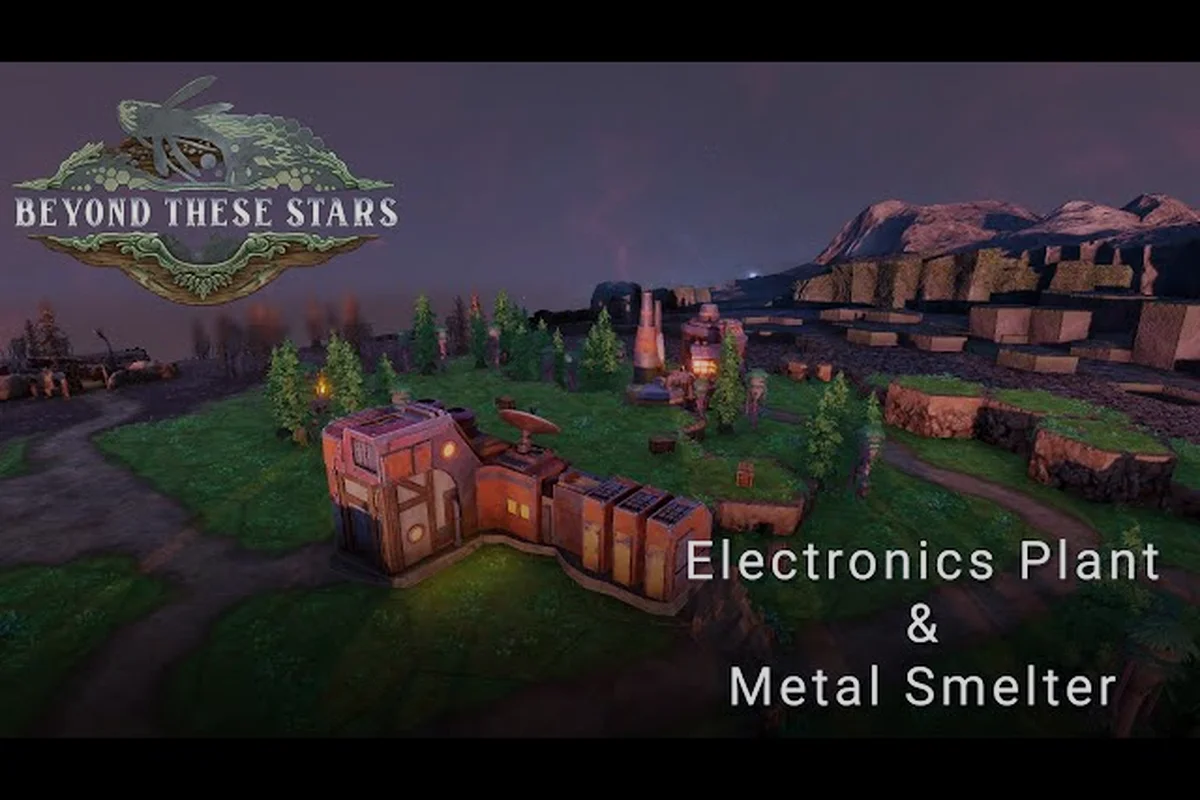
A surprising amount of search traffic around the game asks about an "ore smelter," an "electronics plant," a "metal smelter," and similar heavy-industry buildings. The honest answer is that none of those buildings are in the verified building list for the October 2026 1.0 release, and the developer has been explicit about why. The 1.0 release deliberately omits stone and ore deposits, and the studio has called that omission "intentional." There is no published ore, alloy, refined metal, coolant, fuel grade, or Rocket Assembly chain. There is no "Space Layer" technology and no per-tile yield to optimize.
| Search keyword | Building type implied | In verified 2026-10-16 1.0 building list? | Official status |
|---|---|---|---|
| "Ore smelter" | Smelter-type processing node | No | Intentionally absent — developer states "a lack of stone & ore deposits. This is intentional" |
| "Metal smelter" | Smelter-type processing node | No | Intentionally absent — no published ore, alloy or refined metal chain |
| "Electronics plant" | Research-gated advanced production building | No | Closest in-game concept is the research-unlocked Advanced Goods bucket; inputs/building not yet published |
| "Rocket Assembly" | Late-game ship assembly chain | No | Player-built spacecraft come only from the Spaceship Builder; named ship types only; Settlement Ship is not player-built |
| "Fuel grade / Coolant" | Industrial processing intermediate | No | Not in the verified resources list (Wood, Wood Waste, Food Waste, Water, Chemicals, Wool, Cotton seeds, Shell, top soil, potatoes, soup, Sheep, Cows, Cold/Warm Weather Clothing, Advanced Goods) |
For players mapping their searches to the verified crafting table, those smelter-style keywords function as descriptive shorthand for a processing step that the recipe list does not yet encode; the October 2026 1.0 build ships with biomass, food, packs, and prefab recipes only, so any guide promising an "ore smelter" or "metal smelter" output is referencing a building that simply does not exist in this release window and will remain absent until the developer adds a smelter-type processing node to the chain.
-
Searches for a Beyond These Stars ore smelter do not resolve to a real building. The right framing is "this game ships without ore income by design."
-
Searches for a Beyond These Stars metal smelter hit the same wall. There is no smelter-type processing building in the verified list, and the developer has not hinted at one in any Dev Blog from #22 through #29.
-
Searches for a Beyond These Stars electronics plant point to a category that does not exist yet. The closest in-game concept is the research-gated Advanced Goods bucket, and the developer has not published what Advanced Goods are made from or in which building.
The right move when you see those keywords in a guide is to treat them as type-level descriptions, not proper nouns. If a future patch adds a smelter-type processing building, the recipe list will grow; until then, the table in the previous section is the complete answer.
The Wood and Wood Waste Loop
Wood and Wood Waste deserve a closer look because they are the most visible loop in the early game. The Burner is the building that touches both. According to the official material, the Burner can be set to consume the Wood resource, which means it doubles as a recycling option for branches and scrap wood that would otherwise clutter storage. Wood Waste is the named by-product elsewhere in the developer's resource list, and it is the input that the Composting building expects alongside Food Waste.
A clean Wood and Wood Waste loop in beyond these stars crafting recipes follows a fixed four-step production chain that the Burner and Composting building close without any external input. Tree Nursery output feeds the Burner's Wood consumption setting, which incinerates branches and scrap into Wood Waste, and that by-product is the exact resource the Composting building queues up to output top soil — a feedback material used in both terraforming projects and the potato field upgrades. Treating this chain as a single adjacency problem, rather than four isolated buildings, is what separates an efficient early-game base from one that quietly stalls on hidden biome health decay.
-
A Tree Nursery produces mature trees.
-
A Burner, set to consume Wood, burns scrap and excess branches.
-
Wood Waste moves to the Composting building.
-
Composting outputs top soil, which feeds back into terraforming and the potato fields.
This is the cleanest "zero waste" chain in the entire recipe list, and it is also the one players most often break by accident. If your Burner is misconfigured or your Composting building is too far from storage, Wood Waste piles up and your biome health takes a slow, invisible hit. Lay the buildings adjacent, route Wood Waste to Composting first, and let the loop close itself.
Advanced Goods, Research, and the Late-Game Recipe Frontier
Advanced Goods are the only named late-game crafting category the developer has published, and they are intentionally vague. The developer has confirmed that Advanced Goods are unlocked through research, but has not published what Advanced Goods are made from or in which workshop they are produced. That is the official negative, and the honest recipe-list framing is: there is a research-gated advanced production tier, its inputs and outputs are not yet documented, and the official Beginner Guide does not include a recipe for it.
For players planning a settlement around the still-unrevealed Advanced Goods production tier, that means two practical habits: stockpile the verified basic inputs — Wood, Water, Chemicals, Wool, top soil, potatoes and Shell — in surplus rather than selling them off, and queue research aggressively so that the moment the developer documents Advanced Goods recipes, you already have the resource base and the unlocks to begin producing without a costly ramp-up.
-
Keep your early chains (food, clothing, pollution, space logistics) running smoothly, because the resource base they build is what you will spend on Advanced Goods research and production once the recipes land.
-
Watch the developer's articles hub and the Steam news page, because Advanced Goods recipes are the single most likely place for the recipe list to grow in the first post-launch patches.
A useful piece of internal cross-context is that the broader Beyond These Stars production chains guide covers the strategic side of running multiple chains in parallel, while this article is the recipe-level reference. If you are planning your first three settlements together, the production chains guide is the better starting point; if you are wondering which building eats which resource, this is the article you want open in a second tab.
Putting the Recipe List to Work in a First Settlement
A practical first-settlement order based on the verified recipe list goes like this: the sequence below is tuned to the October 2026 launch crafting roster, where the Kitchen, Pasture, Cleaner, Tree Nursery, Composting chain, and Space Port are the only confirmed production nodes tied to finished goods. Following this order means every early build is gated by a recipe the player already has access to, not by an Early Access chain that may be rebalanced later. Treat it as a dependency-first queue — Potatoes unlock Soup, Sheep unlock Wool Cloth, Wood Waste unlocks the Composting loop — so every step only comes online once a steady verified finished-goods economy is feeding your Peeps.
| Build order step | Building placed | Verified resource it consumes | Production output | Why it gates the next step |
|---|---|---|---|---|
| 1 | Kitchen | Potatoes | Soup (the only named finished meal) | Keeps Peeps fed at the lowest documented input cost while you expand |
| 2 | Pasture + Weaver + Tailor | Sheep → Wool; Cotton seeds | Cold Weather Clothing, Warm Weather Clothing | First finished goods needed for a multi-biome settlement |
| 3 | Cleaner + Tree Nursery | Water + Chemicals; trees | Pollution reduction, biome health recovery | Biome health is the slowest stat in the game to recover per Dev Blog #29 |
| 4 | Burner + Composting | Wood → Wood Waste → Food Waste | Closed Wood/Wood Waste/Composting loop | Unlocks efficient terraforming and the Wood Waste routing from the Burner |
| 5 | Space Port with ≥2 Landing Pads | None consumed at placement | Ship logistics | Research-gated Advanced Goods recipes land faster once logistics are already in place |
-
Build a Kitchen as soon as the starter potatoes come in. Soup is the only named finished meal and the cheapest way to keep Peeps fed while you expand.
-
Build a Pasture on the nearest planet with sheep, and queue a Weaver plus a Tailor. Cold and Warm Weather Clothing are the first finished goods you will need for a multi-biome settlement.
-
Place at least one Cleaner and one Tree Nursery in your pollution hotspots. Biome health is the slowest stat in the game to recover and the easiest to lose.
-
Configure the Burner to consume Wood and route its Wood Waste into a Composting building. Closing this loop early is what unlocks efficient terraforming later.
-
Build your first Space Port with two or more Landing Pads before you research Advanced Goods, because the recipes for advanced production will land faster if your logistics are already in place.
The recipe list is short on purpose. The 1.0 release skipped Early Access entirely, and the developer has been careful to ship a smaller, well-documented set of chains rather than a sprawling, half-balanced tree. Treat the table in this guide as the complete answer for the October 2026 launch, and revisit the developer's official channels as new recipes land.
Frequently Asked Questions
Where can I find the full Beyond These Stars recipe list?
The most complete current list is the table in this guide, which is built from the developer's Official Beginner's Guide, Dev Blog posts #22 through #29, and the official Steam store page. The developer has not published a downloadable spreadsheet of recipes, and the game shipped on October 16, 2026, so third-party wiki coverage is essentially absent.
Is there an ore smelter or metal smelter building in Beyond These Stars?
No. The October 2026 1.0 release deliberately omits stone and ore deposits, and the studio has called that decision "intentional." There is no Beyond These Stars ore smelter, no metal smelter, and no smelter-type processing building in the verified workshop list. Heavy-industry searches resolve to a mechanic that does not exist in the current build.
How do I turn Wood Waste and Food Waste into something useful?
Route both into a Composting building. The named output of Composting is top soil, which feeds back into terraforming and your potato fields. Closing this loop is what unlocks efficient terraforming later in the game and is the cleanest zero-waste production chain in the recipe list.
What are Advanced Goods, and how do I craft them?
Advanced Goods are a research-gated category the developer has confirmed exists but has not documented in detail. The developer has not published what Advanced Goods are made from, in which building they are produced, or what unlocks the relevant research node. Treat the category as "exists, recipes not yet published" and check the developer articles hub for the first post-launch patches that will likely fill in the gaps.
Can I build a Settlement Ship myself?
No. The Settlement Ship is delivered to your settlement, not built by the player. The Spaceship Builder is the workshop that produces the player-built spacecraft, and it is limited to the named ship types in the verified building list. For a broader look at how the recipe list connects to your wider settlement economy, the Beyond These Stars resources guide covers every named resource and where each one enters a production chain.