
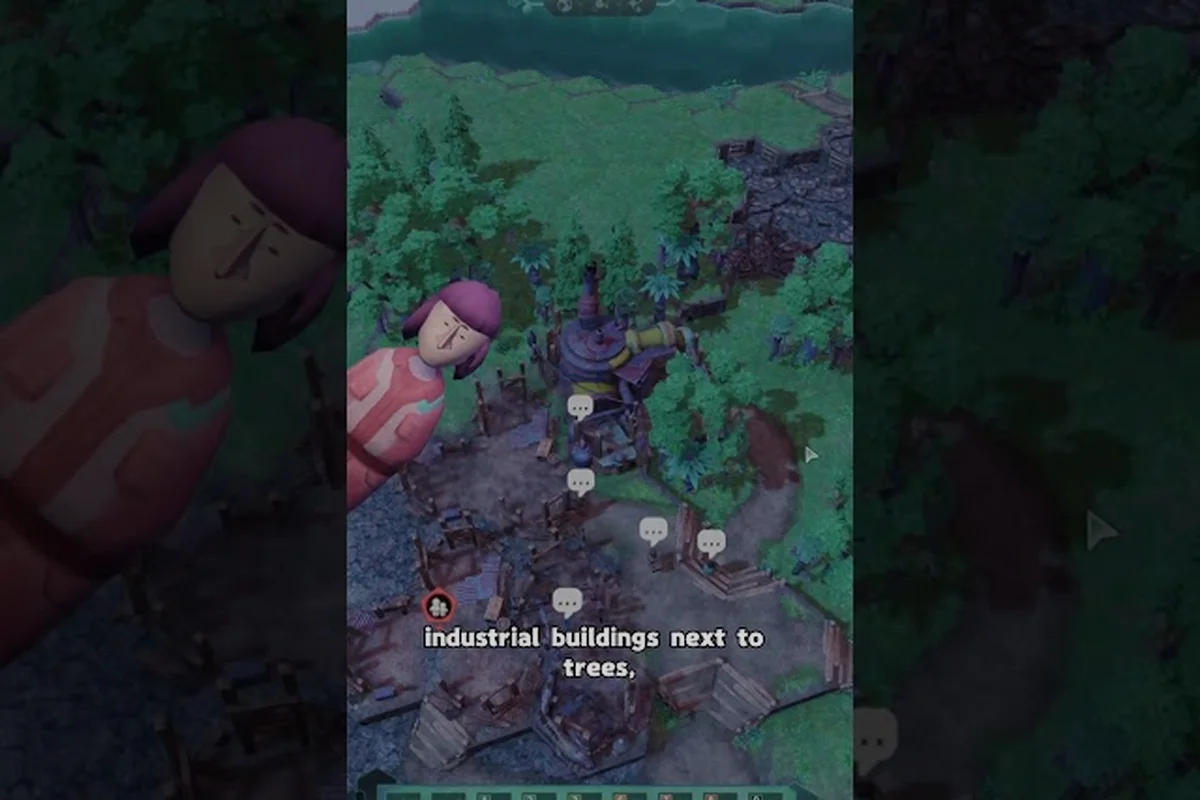
In Beyond These Stars, every decision about how a sustainable city grows, mines, and heals the land beneath it is shaped by the same pressure: Kewa, the sentient Space Whale the Peeps call home, is a fragile host whose hide can be poisoned by over-extraction and restored only through deliberate terraforming. This page examines why sustainability sits at the centre of the game's design loop, how raising biome health through canals, top soil, and tree planting counterbalances the damage inflicted by mining the very ground your settlement rests on, and the recurring trade-off the player faces between pulling resources from the local tile and routing the colony to richer deposits elsewhere.
Why Sustainability Is the Core Question in Beyond These Stars
A Beyond These Stars sustainable city is not a side project — it is the central design challenge. Peeps settle on the back of Kewa, a sentient Space Whale drifting between star systems, and every structure you raise has to answer one underlying question: will this city still be feeding, clothing, and sheltering its people when the next climate swing hits? The game's developer, Balancing Monkey Games (the Dunedin / Ōtepoti, New Zealand studio behind the predecessor title the developer's launch post), built the entire loop around that question. Released on 2026-10-16 as a straight-to-1.0 launch, the title gives players a single living canvas — Kewa's biome — and lets them terraform, plant, build, and balance their way toward a city that survives heat waves, cold snaps, pollution spikes, and Peep unhappiness.
What makes a sustainable city here different from a normal city-builder win condition is that the city lives on a creature who has feelings. Kewa has their own happiness and health meters. When the galaxy around Kewa turns hot, that temperature pushes Kewa downward; if Kewa's mood drops far enough, they emergency-travel somewhere cold on their own. Your city is, quite literally, a passenger. The green choices you make — what to plant, how to handle pollution, when to lay rivers and canals — are not decoration. They are the difference between Kewa staying calm under your feet and Kewa carrying your whole settlement to a colder patch of sky whether you wanted to go or not.
That framing shapes everything that follows. Before getting into biomes, temperatures, and the exact green choices that hold a settlement together, it helps to look at the three pressures every sustainable city has to absorb: the biome itself (what Kewa's back is made of at the start of the run), the climate the galaxy throws at you (temperature swings that Kewa reacts to), and the green infrastructure you stack on top (forests, rivers, Cleaner buildings, Tree Nurseries, and the way you route pollution). Each of these three pressures gets its own section below. A fourth section lays out the practical design choices, and a fifth pulls the framework together with a checklist you can apply to any settlement you start.
The Biome Layer: What Kewa's Back Is Made Of
The first thing a new colony founder should understand is the difference between a biome and a climate. The biome is the underlying terrain and ecology on Kewa's back — soil quality, vegetation, water access, and the starting health of the local ecosystem. The climate is the temperature condition the galaxy is in at the moment, which Kewa responds to. A green city that thrives in a cold-galaxy climate can fall apart in a hot-galaxy one, and the reverse is also true. The official Beyond These Stars website frames terraforming, forests, and pollution as the three things that keep the biome healthy, and the developer news hub lists "terraforming and the biome" as a recurring topic across the Dev Blog series.
Why the Biome Matters More Than the Climate
Players sometimes treat the climate as the only long-term threat, because Kewa's reactions to temperature are the most visible. In practice, the biome is the slow-building pressure. If the biome is unhealthy — because Pollution has crept up, because forests have been cut and not replaced, because rivers and canals are missing — Peeps will get sick, production chains will slow, and strikes become more likely. Dev Blog #29, the most recent of the developer articles linked from the news hub, calls out planting trees, minimising Pollution, and creating rivers as the three habits that keep the biome healthy. None of those are climate answers. They are biome answers.
A practical way to think about it: the biome is the soil your city grows in, and the climate is the weather. A city can survive bad weather on good soil, but it cannot survive bad soil under any weather.
The Biome Types You Will Encounter
The developer has not published a numbered, fully-typed biome list. What official material confirms is that biomes vary by starting terrain (flat, hilly, with or without surface water) and by climate condition (cold, moderate, hot). Dev Blog #28 introduces a "Neutral Sector" node that contains a moderate-climate planet with chickens and cows, which is the cleanest official hint that planet biomes also carry temperature tags. A working mental model is that biomes are combinations of two axes:
| Axis | What It Means in Play | Official Hint |
|---|---|---|
| Starting terrain | Flat ground builds faster; hilly ground rewards canals and reshaping | Dev Blog #29 mentions digging canals and reshaping land as part of keeping the biome healthy |
| Temperature tag | Hot, moderate, or cold biome; Kewa's reaction to galaxy temperature is mediated by which biome you are in | Dev Blog #28's Neutral Sector is described as "moderate-climate" |
The cleanest takeaway for a beyond these stars biome guide is this: rather than memorise biome names, classify what you see at settlement start by terrain and temperature, then match your green design to both. A flat cold biome and a hilly hot biome are not the same design problem, even though both are "Beyond These Stars" settlements.
Biome Health: Reading the Direction of Travel
Dev Blog #29 also confirms there is a biome-health concept that responds to your terraforming choices. The developer has not published a numeric threshold, so treat biome health as a direction, not a number: when Pollution is rising, forests are shrinking, and rivers are missing, biome health is heading down. When Tree Nurseries are active, when a Cleaner is mixing Water and Chemicals to keep Pollution in check, and when canals route water through the settlement, biome health holds or climbs. The official Beginner Guide on Steam Community covers terraforming in the same breath as technology and Peep care, which is a good signal that the developer wants players to treat all three as one system rather than three separate optimisations.
The Climate Layer: Temperature, Galaxy, and Kewa's Mood
Climate is the layer most newcomers notice first, because Kewa reacts out loud. A cold galaxy does not bother Kewa; a hot galaxy drags Kewa's happiness down. Dev Blog #29 is the single most important source for this: if Kewa's mood falls far enough under heat stress, Kewa starts emergency travel to a cooler star system on their own, dragging the whole city with them. That is not a threat in the usual game sense — there is no combat in the game, and the developer has confirmed the title has no enemies or bosses. It is a logistical surprise. You may wake up in a different climate band than the one you designed for, with all your green choices suddenly mismatched.
Why Temperature Control Is a Top-Level Concern
A beyond these stars temperature guide has to start with one blunt fact: you do not fully control the galaxy's temperature, but you do control how much the city is exposed to it. Kewa decides where the Space Whale travels between, but your building choices affect how resilient the city is to whatever the climate throws at it. The Tailor produces Cold Weather Clothing and Warm Weather Clothing from fabrics, the Apothecary heals Peeps who fall sick under climate stress, and the Kitchen turns ingredients into meals so Peeps can keep their energy up at the start of a shift. Climate does not damage buildings directly; it wears down Peeps, and Peeps in poor shape are what cascade into strikes, sickness, and (in the worst case) Peep death and mourning, all of which Dev Blogs #22, #23, and #25 document.
Climate Bands and What They Demand
The developer has not published a numeric temperature table, so the climate band framework below is a type-level description of what official material implies. Think of it as the working climate guide a green city founder uses in their head, not as a leaked developer formula.
| Climate Band | Kewa's Reaction | Settlement Pressure | Green Design Response |
|---|---|---|---|
| Cold | Kewa is comfortable; happiness steady | Peeps need Cold Weather Clothing; energy drops fast in early shifts | Stockpile fabrics, build a Tailor early, prioritise warm meal production in the Kitchen |
| Moderate | Kewa is neutral; the easiest long window for growth | Peep sickness is lower; biome can be reshaped at leisure | Use the moderate window to dig canals, plant forests, and bring Pollution down before the next swing |
| Hot | Kewa's happiness drops; emergency travel risk rises if it falls far enough | Peeps need Warm Weather Clothing; sickness chance climbs as energy falls at shift start | Lean on Apothecary access, push Pollution down, and avoid cutting forests to free space for industry |
The same green choices look different in each band. Planting forests is a biome play in the cold band, a sickness-buffer play in the moderate band, and a survival play in the hot band. That is the value of a beyond these stars climate guide that treats climate and biome as one system rather than two.
What "Sustainable" Actually Means in a Climate Context
Sustainability here is not "the city survives one hot galaxy." It is "the city survives the next climate swing without losing population, without losing Kewa's trust, and without losing biome health." That is why Dev Blog #29 names pollution, forests, and rivers as the three green habits, and that is why the developer's own Beginner Guide groups terraforming, Peep care, and Kewa care under one roof. A sustainable city has to be flexible across climate bands, and the only way to be flexible is to invest in the systems that are useful in every band — water routing, fabric production, meal variety, and forest cover.
The Green Design Layer: Forests, Pollution, Water, and What the Developer Has Actually Named
A beyond these stars green city guide has to walk a careful line: the developer has published the names and roles of the key buildings, but they have not published cost tables, output rates, or pollution thresholds. Anything that pretends to those numbers is invented. The honest version of a green design guide names the verified buildings, explains the role each one plays, and leaves the player's own experience to fill in the exact numbers as the launch community plays the game. tends to those numbers is invented, and if you want to see how a published companion piece walks readers through that same terrain step by step, our Beyond These Stars terraforming walkthrough shows how the mechanics are actually layered once a match is underway.
The Verified Green Design Toolkit
The buildings and systems below are all named in the official Beginner Guide, in the Dev Blog series, or in the official press kit. Each one has a clear role in keeping a Beyond These Stars sustainable city actually sustainable.
| Tool | Official Role | What It Does For a Green City |
|---|---|---|
| Tree Nursery | Plants trees | An indirect way to address Pollution, per official material; also rebuilds forest cover that biome health depends on |
| Cleaner | Peeps mix Water and Chemicals to clean | The more direct way to address Pollution, per official material |
| Burner | Can be set to consume the Wood resource | Lets a city dispose of Wood Waste and Food Waste in a controlled way, which is part of keeping the biome clean |
| Composting | Officially listed building | Handles Food Waste stream so it does not pile up in the biome |
| Trawler | Harvests the Shell resource | A water-side industry; useful in green cities that want productive river and coast work |
| Weaver | Converts raw materials into fabrics | Feeds the Tailor so the city can switch between Cold and Warm Weather Clothing as the climate changes |
| Tailor | Makes Cold and Warm Weather Clothing | The single building that lets a settlement adapt to a climate band shift |
| Apothecary | Heals sick Peeps | Keeps Peeps functional through climate stress, which keeps production chains running |
| Kitchen | Turns ingredients into meals | The soup resource and other meals give Peeps energy at the start of a shift, which lowers sickness risk (Dev Blog #25) |
| Pasture | Produces Wool on a planet with sheep; Cotton seeds can be found | Feeds the Weaver so fabric supply does not bottleneck during a cold snap |
| Fairground | Where Peeps hold Celebrations (Dev Blog #22) | Celebrations require Peeps to pass a high happiness threshold and grant production, movement, and sickness bonuses — a green city's reward loop |
| Home Spaceship | Early building that produces what the first Peeps need | The starting anchor; how the green city is born |
That list is not aspirational. Every entry above is from the verified buildings list the developer has published, and the resource list behind them — Wood, Wood Waste, Food Waste, Water, Chemicals, Wool, Cotton seeds, Shell, top soil, potatoes, soup, Sheep, Cows, Cold Weather Clothing, Warm Weather Clothing, and Advanced Goods (unlocked by research) — is also official. Notably absent from both lists are stone and ore deposits, which the developer has stated are intentionally absent from the game. A beyond these stars sustainable city does not run on a smelter; it runs on top soil, water, forests, and Peep energy.
How the Green Toolkit Maps to the Three Pressures
A useful mental model is to attach each green tool to the pressure it answers. The table below does that without inventing numbers; it is type-level, not a stat sheet. That mapping is the spine of a green city. Every sustainable settlement hits each row eventually, and the order in which the rows get answered is what separates a city that survives the first climate swing from a city that does not.
| Pressure | Primary Green Answer | Secondary Green Answer |
|---|---|---|
| Biome health dropping | Tree Nursery (rebuilds forest cover) | Cleaner (cuts Pollution) |
| Pollution rising | Cleaner (mixes Water and Chemicals) | Tree Nursery (indirect) |
| Water flow problems | Dig canals and reshape land (Dev Blog #29) | Trawler (productive use of the water network) |
| Hot galaxy, Kewa unhappy | Reduce Pollution, keep forests intact | Tailor output of Warm Weather Clothing |
| Cold galaxy, Peeps cold | Tailor output of Cold Weather Clothing | Kitchen for warm meals early in the shift |
| Peep sickness rising | Apothecary (heals) | Kitchen energy at shift start (Dev Blog #25) |
| Waste piling up | Burner (Wood), Composting (Food Waste) | Reduce upstream production rather than burning more |
What the Green Toolkit Does Not Include
A few related decisions show up in player discussions and are worth addressing openly: The practical design of a sustainable city is less about any single trick and more about the order in which you answer the three pressures. A first run tends to fail because the player treats the climate as a one-time event, when in fact the galaxy's temperature can change between sessions, and Kewa's mood can drop in a single hot band. The design below is the order that the verified buildings and the Dev Blog series collectively support.
-
Smelters, ore processing, and metal chains are not in the game. The developer has confirmed the deliberate absence of stone and ore deposits, so a green city is not a "no-industry" city — it is a city whose industry runs on organics, fabrics, and water.
-
Trade stations are map nodes, not buildings. Dev Blog #28 places trade stations among the things a Galaxy Map node can hold, alongside barren planets, space junk, strange objects, and aliens. A green city founder visits them by ship, not by placing a structure. The only player-built space structures are the Space Port, the Landing Pad, and the Spaceship Builder.
-
Advanced Goods are a researched category, not a recipe list. The developer has not published what Advanced Goods are made from or in which building, so treat the category as a research-gated advanced production target, not as a chain you can fully plan today.
Designing a City That Lasts: From Settlement Ship to Kewa's Trust
Phase 1: Land, Survive, and Read the Biome
When the Settlement Ship lands and the player cannot build the ship themselves (the developer has confirmed the Settlement Ship is not player-built), the first job is to read what biome you are in. Is the ground flat or hilly? Is there surface water? What does Kewa's mood look like in dialogue? The choices that follow depend on those answers. A hilly biome rewards resh fuel land work and early canal digging, which keeps biome health trending up. A flat biome rewards spreading out, planting early Tree Nurseries, and getting a Cleaner into the production network before Pollution has a chance to build. In both cases, the first buildings after the Home Spaceship should be a Kitchen (so the soup and other meals exist) and an Apothecary placement, so sickness is treatable on day one.
Phase 2: Lock Down Water, Fabric, and Clothing
Once Peeps are fed and healable, the next pressure is climate. Water is the central resource because the Cleaner needs it, the Trawler needs the water network, and any river or canal work is biome-positive. A Weaver and a Tailor should be the next two buildings on the list, with the Pasture producing Wool and any Cotton seeds found on planet scouting being routed into fabric. At this point the city can switch between Cold Weather Clothing and Warm Weather Clothing depending on the climate band Kewa is in, which is the difference between a city that weathers a swing and a city that breaks on one.
Phase 3: Manage Waste, Pollution, and Forests
Once fabric and food are stable, the green design gets explicit. Burner placement for Wood and Wood Waste, Composting placement for Food Waste, and Tree Nursery placement to keep the forest cover growing all happen in this phase. A Cleaner in the right location cuts Pollution before it can push biome health down. Dev Blog #29 is the clearest official source for this triad: trees down, Pollution up, rivers missing, biome health drops. A green city founder treats the triad as one checklist item rather than three.
Phase 4: Layer in Celebrations, Research, and Outposts
The Fairground is the only building where Peeps hold Celebrations, and Dev Blog #22 explains that Celebrations require enough Peeps in one location to pass a high happiness threshold. The bonuses — production, movement, and sickness — are exactly what a green city wants to compound once the basics are stable. Research unlocks Advanced Goods and other perks (the developer has not published the full tech tree), and Outposts on nearby planets — accessed via the Galaxy Map and its barren planets, space junk, strange objects, trade stations, and aliens — supplement what Kewa's biome alone cannot supply. The Neutral Sector described in Dev Blog #28, with its moderate climate and chickens and cows, is the cleanest example of an outpost planet that complements a Kewa-based city.
Phase 5: Talk to Kewa
The last phase is the one most players forget. Kewa has dialogue, and the choices you make in that dialogue nudge Kewa's happiness, which is the single biggest factor in whether Kewa emergency-travels during a hot galaxy. A sustainable city is one where Kewa is happy enough to ride out a hot band, and that is a function of both the city's physical state and the player's dialogue choices.
Putting It Together: A Sustainability Checklist
A practical way to use the framework above is to keep a short checklist while playing. Every time the climate shifts, every time Kewa's mood moves, and every time you expand land or build a new wing of the city, run through the list.
| Check | What "Healthy" Looks Like | What "Drifting" Looks Like | Quick Recovery Move |
|---|---|---|---|
| Biome health | Forests visible, rivers running, top soil present | Forest cover thin, rivers dry, top soil eroding | Plant a Tree Nursery; dig a canal |
| Pollution level | Low and stable | Rising visibly | Build a Cleaner route; cut the source |
| Climate fit | Right Cold or Warm Weather Clothing in stock | Peeps cold in cold band, hot in hot band | Rebalance the Tailor output |
| Peep energy | Soup and meals from the Kitchen flowing | Energy dropping at shift start (Dev Blog #25) | Push more ingredients into the Kitchen |
| Waste | Wood Waste and Food Waste being burned or composted | Waste piles growing | Add a Burner for wood, a Composting site for food |
| Kewa's mood | Steady in cold and moderate bands; only mildly down in hot bands | Sliding under heat stress | Talk to Kewa, drop Pollution further, ride out the swing |
Each row on that list is a real lever a green city founder can pull. None of them require numbers the developer has not published; they all require attention the player can give. A beyond these stars biome guide and a beyond these stars temperature guide collapse into that checklist, because in practice the green city founder is not switching between systems — they are reading the same city from three angles at once.
The Hard Limits of a Launch-Wiki Green City Guide
Because the game launched on 2026-10-16 and the community wiki ecosystem has not had time to catch up, several things a green city guide would normally be able to say are not yet public. The Steam Community guides hub at launch is essentially the developer's own Official Beginner Guide plus a tiny handful of player-written guides. As of the October 2026 launch snapshot, the developer has not published:
-
A numeric temperature scale or a fixed hot/cold threshold.
-
A pollution threshold or a numeric formula for biome health.
-
The full tech tree, including what Advanced Goods are made from.
-
Building cost tables, output rates, or shift-by-shift production numbers.
-
The exact contents of every Galaxy Map node beyond the categories Dev Blog #28 names.
Treating those as type-level systems (a "happiness threshold" rather than a fixed number; a "research-gated advanced production building" rather than a named structure) is the right move. Filling those gaps with invented numbers would feel authoritative and be wrong, and the launch snapshot of the Steam store page (26 reviews, 21 positive and 5 negative, captured on 2026-10-17) is far too small to argue from. The honest move is to name what is missing, lean on the verified buildings and resources, and let the next month of community play fill in the numbers.
Frequently Asked Questions
What makes a Beyond These Stars sustainable city different from a normal city-builder win condition?
The city lives on Kewa, a sentient Space Whale with their own happiness and health. A sustainable city is one that survives not just the next resource crunch but the next climate swing, because Kewa reacts to a hot galaxy by getting unhappy, and if Kewa's mood drops far enough they emergency-travel to a cooler star system on their own. That is the central design problem the developer's Dev Blog #29 spells out.
How do biomes and climate differ in Beyond These Stars?
The biome is the underlying terrain and ecology on Kewa's back — soil, vegetation, water, and the local ecosystem's health. The climate is the temperature band the galaxy is in, which Kewa reacts to. A hilly biome in a hot climate and a flat biome in a cold climate are different design problems, and the official developer site treats terraforming, forests, and pollution as the three habits that keep the biome healthy regardless of climate.
Which green buildings actually matter for a sustainable city?
The verified toolkit is the Tree Nursery, the Cleaner, the Burner for Wood, Composting for Food Waste, the Trawler for Shell, the Weaver and Tailor for fabric and clothing, the Apothecary for sickness, the Kitchen for meals, the Pasture for Wool, the Fairground for Celebrations, and the Home Spaceship as the starting anchor. Every one of those is named in the official press kit or in the developer's own Beginner Guide, and together they form the green design spine.
What should a player do first when the Settlement Ship lands?
The Settlement Ship is not player-built — the developer has confirmed that — so the first job is to read the biome (flat or hilly, surface water or dry, Kewa's mood in dialogue), get the Kitchen producing meals so Peeps start shifts with energy, and place an Apothecary so sickness is treatable on day one. The next two buildings should be a Weaver and a Tailor, because the right Cold Weather Clothing or Warm Weather Clothing decides whether Peeps hold up when the climate band changes.
Does the temperature guide in Beyond These Stars have published numbers?
No. As of the October 2026 launch, the developer has not published a numeric temperature scale, a fixed hot/cold threshold, or a pollution threshold. The honest version of a temperature guide describes the three bands (cold, moderate, hot), Kewa's reaction to each, and the green design response for each, without inventing a formula. The community wiki ecosystem has not yet caught up with the launch, so for now the verified sources are the official Beginner Guide, the Dev Blog series on the developer news hub, and the player's own observation.